
Clementina Martinez-Masarweh
Founder | Eco-stylist | Sustainable Advocate
Webisode Season 1
Top Guests Webisodes
Subscribe and be part of the movement.
If you care about fashion with meaning, conscious living, and real voices making real impact, you’re in the right place.
Subscribe Newsletter
Receive updates, new episodes, behind-the-scenes content, and sustainability insights.
The Sustainable Latina™ Story
Summary:
In this episode of ZÁY SHEEN Webisodes, Tafreed sits down with Clementina Martinez Masárweh, widely known as Sustainable Latina, to explore her powerful journey from growing up on a migrant farm camp to becoming an award-winning sustainable fashion designer, artist, and filmmaker. She shares how witnessing her father’s activism and the harmful impact of pesticides, along with her mother’s upcycling creativity, shaped her values and fueled her mission to challenge fast fashion from the inside. Clementina talks about her years working in fast fashion, what pushed her to walk away, and how that experience now drives her to expose exploitation, child labor, and the hidden costs of cheap clothing. She dives into the dangers of microplastics in our clothes and bodies, her films like “V the Vert” and “Upcyclers Fashion Climate Front Liners,” and her upcoming project “Cyborg Human,” which imagines a future shaped by our plastic addiction. Throughout the conversation, she offers practical ways people can take action right now, such as shopping their own closet, swapping, thrifting, mending, and supporting innovators in biobased materials, while reminding us that real change starts with awareness, community, and millions of people taking imperfect action together.
The Sustainable Latina™ Story
From Fast Fashion to Future Threads
Some stories stay with you long after the conversation ends, and Clementina Martinez-Masarweh’s journey is one of them. Known online as Sustainable Latina, Clementina grew up on a migrant farm camp where she witnessed the harsh reality of pesticides, labor exploitation, and environmental injustice. Those early experiences became the foundation of her life’s mission to change the fashion industry from within.
In our ZÁY SHEEN Webisodes interview, she shares how her mother’s upcycling habits and her father’s activism shaped her creativity and sense of responsibility. Clementina went on to study fashion, worked inside fast fashion for years, and eventually walked away when she could no longer ignore the exploitation behind cheap clothing. Today, she uses her voice as a designer, artist, and filmmaker to expose the actual cost of the industry and inspire consumers to choose better.
Her films, like V the Vert and Upcyclers Fashion Climate Front Liner,s highlight the dangers of microplastics, pollution, and the systems that keep fast fashion alive. Her next project, Cyborg Human, imagines a future defined by our obsession with plastics and synthetic materials.
Clementina’s message is clear. Start with what you already own, repair what you can, swap with friends, choose secondhand, and support brands pushing for biobased materials. You do not need to be perfect to make an impact. Small steps, taken by millions of people, add up to real change.
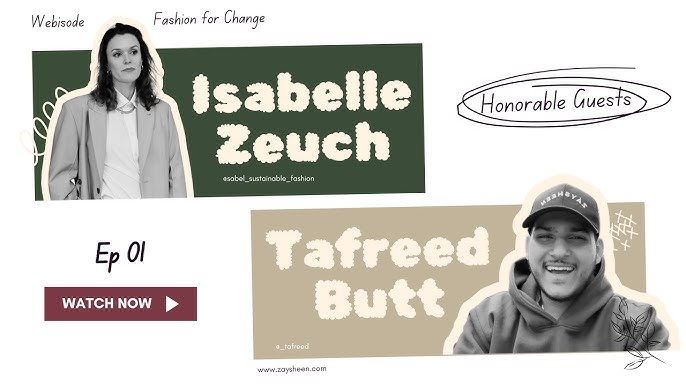
For both Izzy and Tafreed, sustainability is not only about fabric, water usage, or recycling. It is also about the people who make our clothes. Many garment workers in countries like Bangladesh, Pakistan, and Nepal earn far below a living wage. They often work long hours in unsafe environments to produce inexpensive clothing that sells in the West.
Tafreed’s own background in Thailand gave him firsthand experience with this reality. He met workers who did not receive fair wages and saw clothes produced with little regard for quality or ethics. It was this environment that pushed him to say no to fast fashion and to start building something better.
The episode highlights a powerful message. Change begins with awareness. It grows through conversation. And it becomes real when brands and consumers choose ethical production, fair wages, and quality materials.
Fashion lasts longer when it is made with intention. The world becomes cleaner when we buy less and use what we already have. And the industry becomes fairer when we think about the hands behind every stitch.
Fashion for Change is not just a podcast. It is a reminder that style can be beautiful without harming people or the planet. With voices like Izzy and Tafreed, the movement continues to grow, inspiring listeners to choose better, live consciously, and support fashion that values humanity.